Use Scenarios
Learn how Model Broker has shifted and improved companies in different scenarios.
Create intelligent diagrams from legacy P&IDs through DEXPI
Model Broker creates DEXPI files from legacy drawings that can be imported into CAD systems supporting this standard. This enables structured and interoperable P&IDs that seamlessly integrate with digital workflows.

Why intelligent P&IDs matter
Intelligent P&IDs are digital representations that go beyond traditional diagrams. They embed structured data that can be used throughout a plant’s lifecycle. Intelligent P&IDs provide significant advantages in engineering, operations, and maintenance by:
- Improving data consistency: Facilitating seamless data exchange between different engineering and operational systems. This ensures that all stakeholders work with accurate and up-to-date process information.
- Enhancing efficiency: Automating workflows and reducing the need for manual updates. Capturing detailed attributes for each component, including specifications, operational parameters, and relationships.
- Supporting Digital Twins: Providing structured data that can be integrated into digital twin models for real-time monitoring, optimization or predictive maintenance Similarly, intelligent diagram data can be used for linking P&ID data with other management and operational systems.
DEXPI improves P&ID management
DEXPI is the standard for P&ID data exchange. It defines a standardized data model that ensures consistency across different tools and platforms.
DEXPI is supported by major CAD software vendors. It ensures:
DEXPI is supported by major CAD software vendors. It ensures:
Vendor-neutral compatibility
Enabling data transfer between software tools without loss
Collaboration
Allowing engineers, operators, and other stakeholders to work with a consistent dataset.
Future readiness
Supporting the transition to digital process engineering.
Integrating Model Broker and DEXPI into your digital workflow
Integrating Model Broker and DEXPI into your digital workflow improves P&ID management, data accuracy, and system integration. It enables digital initiatives such as predictive maintenance, AI-driven analytics, and operational optimization.
Explore Model Broker and DEXPI to enhance process engineering data management.
Explore Model Broker and DEXPI to enhance process engineering data management.
Create lists of equipment, instrumentation or materials from legacy P&IDs
Model Broker converts legacy diagrams into intelligent, machine-readable data, enabling efficient creation of lists of equipment, instruments, materials and others. Lists are essential for project planning, procurement, asset management and maintenance activities.

Automatic data extraction
Model Broker automatically identifies and extract symbols, connections, and text from engineering diagrams. This reduces the time and potential for errors associated with manual redrawing, data extraction or other analysis methods.
Generation of comprehensive lists
Once the data is extracted, Model Broker can export lists in CSV formats.
Example of these lists are:
Example of these lists are:
Equipment lists
Detailed inventories of all equipment along with their attributes included in the diagrams.
Instruments’ lists
Comprehensive catalogues of instruments, including their identifiers.
Material lists
Extensive records of materials required, for example, for the piping systems.
Model Broker can further enrich these lists with information from other data sources, such as equipment data sheets. The information and structure of these lists can be customized according to your needs.
Export to standardized formats
Model Broker supports exporting the extracted information into various machine-readable formats, such as CSV tables, DEXPI, or PLCopen files. This ensures seamless integration with modern Computer-Aided Design (CAD) software systems and other engineering tools and platforms.
Generate control application code from legacy logic diagrams
through PLCopen XML
through PLCopen XML

PLCopen XML: The standard for automation interchange
PLCopen XML is a standardized format for exchanging PLC programs across different platforms and tools. It ensures seamless interoperability between automation software, simplifying integration, migration, and collaboration.
PLCopen XML reduces vendor lock-in, enhances code reuse, and streamlines development workflows. It is based in IEC 61131-3, making it a powerful asset for modern industrial automation.
PLCopen XML reduces vendor lock-in, enhances code reuse, and streamlines development workflows. It is based in IEC 61131-3, making it a powerful asset for modern industrial automation.
Automate creation of PLCopen XML files with Model Broker
Model Broker converts legacy control logic diagrams into PLCopen XML control application files that can be used for:
- Automatic control application creation.
- Validation of control logic in interlocking and safety functions.
- Creation of control application models for operator training simulators.
By leveraging Model Broker, you can reduce time for control application development based on your existing legacy logic diagrams. It can also be used to enhance safety validation, or to streamline training simulation systems development.
Leverage intelligent P&ID data for AI applications
Leveraging intelligent Piping and Instrumentation Diagram (P&ID) data is crucial for unlocking the potential of AI applications.
Traditional P&ID drawings have long served as static references for plant operations, but with Model Broker, they can now be data assets enabling predictive analytics, asset management, and process optimization.
Traditional P&ID drawings have long served as static references for plant operations, but with Model Broker, they can now be data assets enabling predictive analytics, asset management, and process optimization.

Enhancing asset
management
management
Integrating AI with intelligent P&ID data enables centralized digital twins for seamless tracking and management of equipment. AI-powered systems can analyze real-time sensor data, historical performance trends, and maintenance records to provide actionable insights, reducing downtime and improving overall asset efficiency.
Predictive maintenance for
increased reliability
increased reliability
Predictive maintenance is crucial for more efficient industrial operations. AI can leverage P&ID data to establish equipment relationships, detect anomalies, and predict failures before they occur. Similarly, continuous monitoring of process variables in combination with AI-driven algorithms can help to identify patterns that indicate wear, corrosion, or operational inefficiencies, allowing maintenance teams to act proactively rather than reactively.
Optimization through
AI-driven insights
AI-driven insights
AI applications powered by P&ID data drive process optimization. Machine learning models can analyze complex process flows, identifying bottlenecks and inefficiencies in different operational scenarios. AI can recommend optimal setpoints and workflow adjustments, leading to enhanced productivity, energy efficiency, and cost savings.
Unlocking the future of
smart operations
smart operations
With intelligent P&ID data from your legacy material, AI can help you set the foundation for smarter, more efficient, and more sustainable industrial operations.
Automatic simulation model generation with Model Broker
Availability of structured data formats enables automatic generation of industrial simulation models that can be used for different applications over the process lifecycle.

- Design & engineering
validation:Automatically generating dynamic simulation models from P&IDs enables engineers to validate process designs, test control strategies, and identify potential bottlenecks before physical implementation. - Operator training
simulators (OTS):OTS allow operators to train in a realistic, risk-free virtual environment. These simulation systems enhance operational competency, improve safety awareness, and prepare teams for handling critical process scenarios. - Process optimization &
performance
enhancement:Process simulation, allows operators to analyze system behavior, optimize process parameters, and predict performance outcomes. This leads to improved efficiency, reduced downtime, and lower operational costs.
While DEXPI files of the P&IDs contain all the information needed to model the process structure. Equipment data sheets can be used to enrich the data files used for the automatic simulation model development.
Furthermore, the control application model of the process can be built using Model Broker for obtaining structured data from the control logic diagrams of the targeted system. This approach dramatically reduces development time and errors of industrial simulation solutions.
Build AI-Ready Knowledge Graphs from P&ID Data
Transform your DEXPI XML into semantic RDF knowledge graphs with native support for Neo4j, SPARQL endpoints, and modern graph databases.
Powered by Plant Explorer, Model Broker now enables you to export intelligent P&ID data as W3C-compliant RDF graphs, unlocking advanced AI applications, semantic queries and graph-based analytics for your process engineering data.
Powered by Plant Explorer, Model Broker now enables you to export intelligent P&ID data as W3C-compliant RDF graphs, unlocking advanced AI applications, semantic queries and graph-based analytics for your process engineering data.

RDF & Semantic Web
Standards
Standards
Export your DEXPI data as RDF graphs using the DEXPI 2.0 ontology, following W3C semantic web standards. Access your data through SPARQL endpoints for powerful structured queries that preserve the rich semantic relationships in your P&ID diagrams. This standards-based approach ensures interoperability and future-proof data management.
Graph Database
Ecosystem
Ecosystem
Native Neo4j export brings your P&ID data to life in a modern graph database. Compatible with Apache Jena, GraphDB, Stardog, and other RDF-compliant systems, giving you the flexibility to choose the best graph database for your needs. Bring Your Own Graph Database architecture ensures you're never locked in.
AI & LLM
Integration
Integration
Enable context-aware AI reasoning without information loss. Leverage agentic workflows for data quality validation, schema compliance, and anomaly detection. Bring Your Own LLM (BYOLLM) architecture lets you integrate your preferred AI models for knowledge graph-assisted applications.
Powered by Plant Explorer
The intelligent layer between Model Broker and your knowledge graph
Automatic Synchronization
Real-time updates from Model Broker transformations ensure your knowledge graph stays current. S3 and SharePoint connectors enable seamless integration with your existing workflows. Version control with change tracking helps you manage evolving P&ID data across your organization.
Data Validation & Quality
Structural DEXPI validation and schema compliance checks ensure data integrity before export. Automated quality agents verify completeness and consistency, catching issues early in your data pipeline. Build confidence in your knowledge graph with comprehensive validation.
Data Enrichment
Link external datasets from PDFs, Word documents, and databases to enrich your knowledge graph. Merge multiple data sources to create a comprehensive view of your plant assets. SQL and NoSQL database integration brings all your data together.
SPARQL & Graph Export
Interactive SPARQL query interface lets you explore your data semantically. One-click Neo4j graph export makes it easy to visualize and analyze relationships. RDF/Turtle format download provides flexibility for custom integrations.
See Your P&IDs Come to Life in Neo4j
Export your intelligent P&ID data directly to Neo4j, the world's leading graph database. Visualize complex equipment relationships, run powerful Cypher queries, and unlock graph-based analytics for your process engineering data.
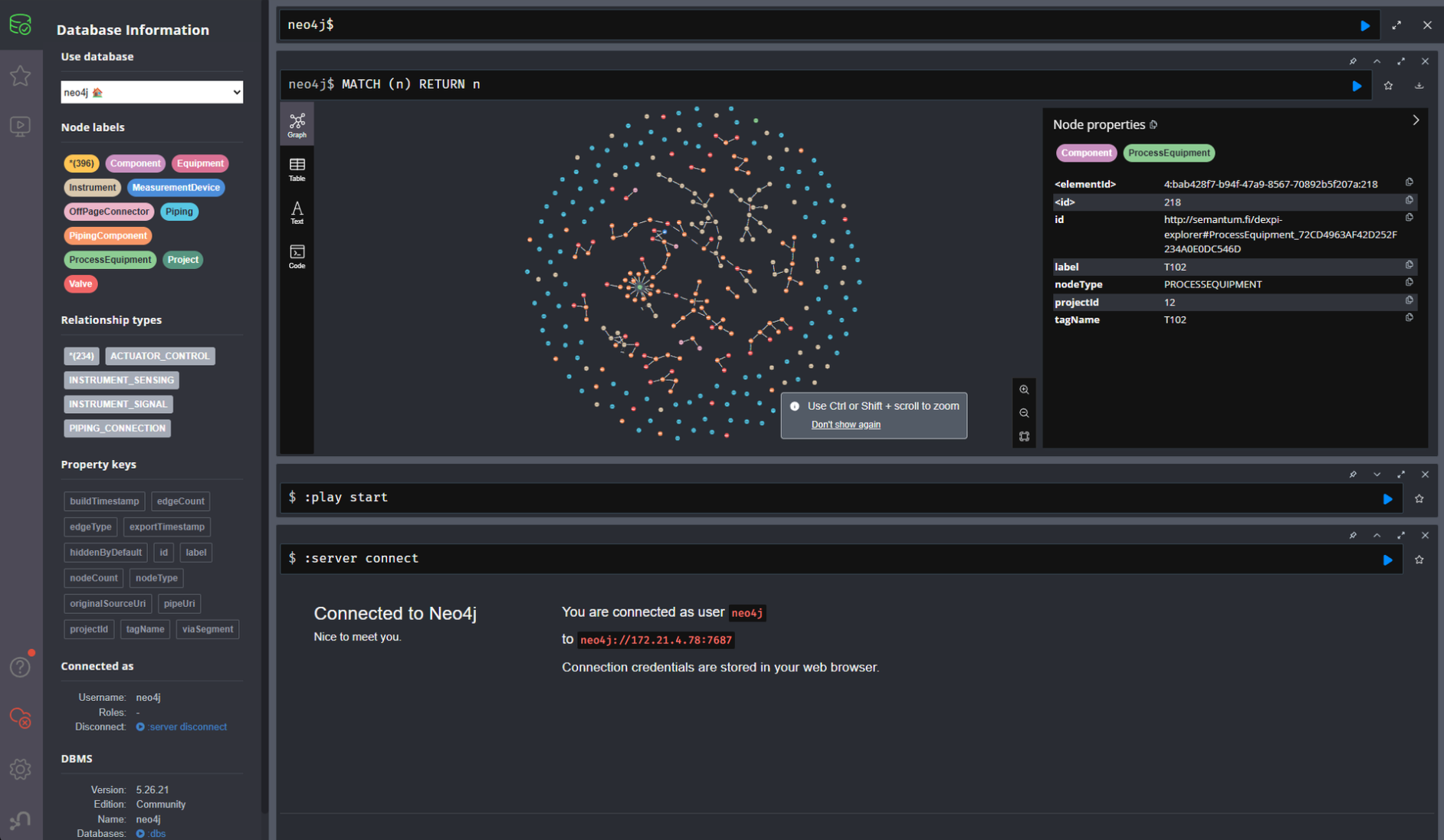
Real P&ID knowledge graph with 1360+ nodes in Neo4j, showing equipment, instruments, valves, and their relationships
1360+
Nodes from P&ID
Multiple
Relationship Types
Rich
Node Properties
Query
With Cypher/SPARQL
Real-World Use Cases
Predictive Maintenance
Use graph-based pattern recognition to identify equipment that may require maintenance. Analyze historical failure patterns across similar equipment types and configurations to predict and prevent issues.
Digital Twin Integration
Connect your P&ID knowledge graph to digital twin platforms using semantic relationships. Enable real-time data flow between physical assets and their digital representations.
Cross-Plant Analytics
Build federated knowledge graphs spanning multiple plants and facilities. Compare configurations, identify best practices, and optimize operations across your entire organization.
Automated Compliance
Use SPARQL rules to automatically check compliance with safety standards and design regulations. Identify potential violations early in the design process and maintain audit trails.
Equipment Genealogy
Track equipment lineage and modification history through graph traversals. Understand dependencies and impact analysis for changes across your process systems.
AI-Powered Insights
Enable natural language queries over your P&ID data using LLMs with knowledge graph context. Build intelligent assistants that understand your plant's configuration and relationships.
Technical Capabilities
Deployment Options
Choose between Semantum-hosted managed service or on-premises deployment. Support for containerized deployment with Docker and Kubernetes, or traditional bare VM installation. Deploy in your preferred cloud or on-premise infrastructure.
Bring Your Own LLM
BYOLLM architecture lets you integrate your preferred AI models without vendor lock-in. Support for agentic workflows with customizable agents for data quality, validation, and domain-specific reasoning tasks.
Ready to Transform Your P&IDs into Knowledge Graphs?
Contact us to learn more about Plant Explorer and how to export your intelligent P&ID data to Neo4j and other graph databases.
Create intelligent diagrams from legacy P&IDs through DEXPI
Create intelligent diagrams from legacy P&IDs through DEXPI
Model Broker creates DEXPI files from legacy drawings that can be imported into CAD systems supporting this standard. This enables structured and interoperable P&IDs that seamlessly integrate with digital workflows.
Why intelligent P&IDs matter
Intelligent P&IDs are digital representations that go beyond traditional diagrams. They embed structured data that can be used throughout a plant’s lifecycle. Intelligent P&IDs provide significant advantages in engineering, operations, and maintenance by:
- Improving data consistency: Facilitating seamless data exchange between different engineering and operational systems. This ensures that all stakeholders work with accurate and up-to-date process information.
- Enhancing efficiency: Automating workflows and reducing the need for manual updates. Capturing detailed attributes for each component, including specifications, operational parameters, and relationships.
- Supporting Digital Twins: Providing structured data that can be integrated into digital twin models for real-time monitoring, optimization or predictive maintenance Similarly, intelligent diagram data can be used for linking P&ID data with other management and operational systems.
DEXPI improves P&ID management
DEXPI is the standard for P&ID data exchange. It defines a standardized data model that ensures consistency across different tools and platforms.
DEXPI is supported by major CAD software vendors. It ensures:
DEXPI is supported by major CAD software vendors. It ensures:
Vendor-neutral compatibility
Enabling data transfer between software tools without loss
Collaboration
Allowing engineers, operators, and other stakeholders to work with a consistent dataset.
Future readiness
Supporting the transition to digital process engineering.
Integrating Model Broker and DEXPI into your digital workflow
Integrating Model Broker and DEXPI into your digital workflow improves P&ID management, data accuracy, and system integration. It enables digital initiatives such as predictive maintenance, AI-driven analytics, and operational optimization.
Explore Model Broker and DEXPI to enhance process engineering data management.
Explore Model Broker and DEXPI to enhance process engineering data management.
Create lists of equipment, instrumentation or materials from legacy P&IDs
Create lists of equipment, instrumentation or materials from legacy P&IDs
Model Broker converts legacy diagrams into intelligent, machine-readable data, enabling efficient creation of lists of equipment, instruments, materials and others. Lists are essential for project planning, procurement, asset management and maintenance activities.
Automatic data extraction
Model Broker automatically identifies and extract symbols, connections, and text from engineering diagrams. This reduces the time and potential for errors associated with manual redrawing, data extraction or other analysis methods.
Generation of comprehensive lists
Once the data is extracted, Model Broker can export lists in CSV formats.
Example of these lists are:
Example of these lists are:
Equipment lists
Detailed inventories of all equipment along with their attributes included in the diagrams.
Instruments’ lists
Comprehensive catalogues of instruments, including their identifiers.
Material lists
Extensive records of materials required, for example, for the piping systems.
Model Broker can further enrich these lists with information from other data sources, such as equipment data sheets. The information and structure of these lists can be customized according to your needs.
Export to standardized formats
Model Broker supports exporting the extracted information into various machine-readable formats, such as CSV tables, DEXPI, or PLCopen files. This ensures seamless integration with modern Computer-Aided Design (CAD) software systems and other engineering tools and platforms.
Generate control application code from legacy logic diagrams through PLCopen XML
Generate control application code from legacy logic diagrams
through PLCopen XML
through PLCopen XML
PLCopen XML: The standard for automation interchange
PLCopen XML is a standardized format for exchanging PLC programs across different platforms and tools. It ensures seamless interoperability between automation software, simplifying integration, migration, and collaboration.
PLCopen XML reduces vendor lock-in, enhances code reuse, and streamlines development workflows. It is based in IEC 61131-3, making it a powerful asset for modern industrial automation.
PLCopen XML reduces vendor lock-in, enhances code reuse, and streamlines development workflows. It is based in IEC 61131-3, making it a powerful asset for modern industrial automation.
Automate creation of PLCopen XML files with Model Broker
Model Broker converts legacy control logic diagrams into PLCopen XML control application files that can be used for:
- Automatic control application creation.
- Validation of control logic in interlocking and safety functions.
- Creation of control application models for operator training simulators.
By leveraging Model Broker, you can reduce time for control application development based on your existing legacy logic diagrams. It can also be used to enhance safety validation, or to streamline training simulation systems development.
Leverage intelligent P&ID data for AI applications
Leverage intelligent P&ID data for AI applications
Leveraging intelligent Piping and Instrumentation Diagram (P&ID) data is crucial for unlocking the potential of AI applications.
Traditional P&ID drawings have long served as static references for plant operations, but with Model Broker, they can now be data assets enabling predictive analytics, asset management, and process optimization.
Traditional P&ID drawings have long served as static references for plant operations, but with Model Broker, they can now be data assets enabling predictive analytics, asset management, and process optimization.
Enhancing asset
management
management
Integrating AI with intelligent P&ID data enables centralized digital twins for seamless tracking and management of equipment. AI-powered systems can analyze real-time sensor data, historical performance trends, and maintenance records to provide actionable insights, reducing downtime and improving overall asset efficiency.
Predictive maintenance for
increased reliability
increased reliability
Predictive maintenance is crucial for more efficient industrial operations. AI can leverage P&ID data to establish equipment relationships, detect anomalies, and predict failures before they occur. Similarly, continuous monitoring of process variables in combination with AI-driven algorithms can help to identify patterns that indicate wear, corrosion, or operational inefficiencies, allowing maintenance teams to act proactively rather than reactively.
Optimization through
AI-driven insights
AI-driven insights
AI applications powered by P&ID data drive process optimization. Machine learning models can analyze complex process flows, identifying bottlenecks and inefficiencies in different operational scenarios. AI can recommend optimal setpoints and workflow adjustments, leading to enhanced productivity, energy efficiency, and cost savings.
Unlocking the future of
smart operations
smart operations
With intelligent P&ID data from your legacy material, AI can help you set the foundation for smarter, more efficient, and more sustainable industrial operations.
Automatic simulation model generation with Model Broker
Automatic simulation model generation with Model Broker
Availability of structured data formats enables automatic generation of industrial simulation models that can be used for different applications over the process lifecycle.
- Design & engineering
validation:Automatically generating dynamic simulation models from P&IDs enables engineers to validate process designs, test control strategies, and identify potential bottlenecks before physical implementation. - Operator training
simulators (OTS):OTS allow operators to train in a realistic, risk-free virtual environment. These simulation systems enhance operational competency, improve safety awareness, and prepare teams for handling critical process scenarios. - Process optimization &
performance
enhancement:Process simulation, allows operators to analyze system behavior, optimize process parameters, and predict performance outcomes. This leads to improved efficiency, reduced downtime, and lower operational costs.
While DEXPI files of the P&IDs contain all the information needed to model the process structure. Equipment data sheets can be used to enrich the data files used for the automatic simulation model development.
Furthermore, the control application model of the process can be built using Model Broker for obtaining structured data from the control logic diagrams of the targeted system. This approach dramatically reduces development time and errors of industrial simulation solutions.
Build AI-ready knowledge graphs with RDF and Neo4j
Build AI-Ready Knowledge Graphs from P&ID Data
Transform your DEXPI XML into semantic RDF knowledge graphs with native support for Neo4j, SPARQL endpoints, and modern graph databases.
Powered by Plant Explorer, Model Broker now enables you to export intelligent P&ID data as W3C-compliant RDF graphs, unlocking advanced AI applications, semantic queries and graph-based analytics for your process engineering data.
Powered by Plant Explorer, Model Broker now enables you to export intelligent P&ID data as W3C-compliant RDF graphs, unlocking advanced AI applications, semantic queries and graph-based analytics for your process engineering data.
RDF & Semantic Web
Standards
Standards
Export your DEXPI data as RDF graphs using the DEXPI 2.0 ontology, following W3C semantic web standards. Access your data through SPARQL endpoints for powerful structured queries that preserve the rich semantic relationships in your P&ID diagrams. This standards-based approach ensures interoperability and future-proof data management.
Graph Database
Ecosystem
Ecosystem
Native Neo4j export brings your P&ID data to life in a modern graph database. Compatible with Apache Jena, GraphDB, Stardog, and other RDF-compliant systems, giving you the flexibility to choose the best graph database for your needs. Bring Your Own Graph Database architecture ensures you're never locked in.
AI & LLM
Integration
Integration
Enable context-aware AI reasoning without information loss. Leverage agentic workflows for data quality validation, schema compliance, and anomaly detection. Bring Your Own LLM (BYOLLM) architecture lets you integrate your preferred AI models for knowledge graph-assisted applications.
Powered by Plant Explorer
The intelligent layer between Model Broker and your knowledge graph
Automatic Synchronization
Real-time updates from Model Broker transformations ensure your knowledge graph stays current. S3 and SharePoint connectors enable seamless integration with your existing workflows. Version control with change tracking helps you manage evolving P&ID data across your organization.
Data Validation & Quality
Structural DEXPI validation and schema compliance checks ensure data integrity before export. Automated quality agents verify completeness and consistency, catching issues early in your data pipeline. Build confidence in your knowledge graph with comprehensive validation.
Data Enrichment
Link external datasets from PDFs, Word documents, and databases to enrich your knowledge graph. Merge multiple data sources to create a comprehensive view of your plant assets. SQL and NoSQL database integration brings all your data together.
SPARQL & Graph Export
Interactive SPARQL query interface lets you explore your data semantically. One-click Neo4j graph export makes it easy to visualize and analyze relationships. RDF/Turtle format download provides flexibility for custom integrations.
See Your P&IDs Come to Life in Neo4j
Export your intelligent P&ID data directly to Neo4j, the world's leading graph database. Visualize complex equipment relationships, run powerful Cypher queries, and unlock graph-based analytics for your process engineering data.
Real P&ID knowledge graph with 1360+ nodes in Neo4j, showing equipment, instruments, valves, and their relationships
1360+
Nodes from P&ID
Multiple
Relationship Types
Rich
Node Properties
Query
With Cypher/SPARQL
Real-World Use Cases
Predictive Maintenance
Use graph-based pattern recognition to identify equipment that may require maintenance. Analyze historical failure patterns across similar equipment types and configurations to predict and prevent issues.
Digital Twin Integration
Connect your P&ID knowledge graph to digital twin platforms using semantic relationships. Enable real-time data flow between physical assets and their digital representations.
Cross-Plant Analytics
Build federated knowledge graphs spanning multiple plants and facilities. Compare configurations, identify best practices, and optimize operations across your entire organization.
Automated Compliance
Use SPARQL rules to automatically check compliance with safety standards and design regulations. Identify potential violations early in the design process and maintain audit trails.
Equipment Genealogy
Track equipment lineage and modification history through graph traversals. Understand dependencies and impact analysis for changes across your process systems.
AI-Powered Insights
Enable natural language queries over your P&ID data using LLMs with knowledge graph context. Build intelligent assistants that understand your plant's configuration and relationships.
Technical Capabilities
Deployment Options
Choose between Semantum-hosted managed service or on-premises deployment. Support for containerized deployment with Docker and Kubernetes, or traditional bare VM installation. Deploy in your preferred cloud or on-premise infrastructure.
Bring Your Own LLM
BYOLLM architecture lets you integrate your preferred AI models without vendor lock-in. Support for agentic workflows with customizable agents for data quality, validation, and domain-specific reasoning tasks.
Ready to Transform Your P&IDs into Knowledge Graphs?
Contact us to learn more about Plant Explorer and how to export your intelligent P&ID data to Neo4j and other graph databases.